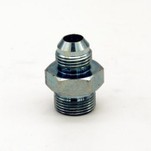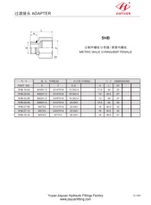

There are three main types of hydraulic hose fittings or connectors,Metal Seal Connectors,Tapered Threads,Soft Seal Connectors
All hydraulic connectors need to fulfil two functions, they must seal and hold.
Sometimes one mechanism will provide both functions and sometimes they are done by using two parts of the same mechanism.
Tapered pipe connectors
The first types of hydraulic connectors developed were tapered threads. These work because the threads are cut on a taper with the diameter of the pipe, changing along the threaded area of the pipe making the connection tighter as it’s done up.
Tapered pipe connections require a sealer to ensure they do not leak. This can be a tape sealant or the usually preferred method, a chemical sealant.
Often it’s difficult to orient tapered pipe threads correctly, which can cause a poor seal and a tendency to leak under pressure. These types of fittings can also damage other types of fittings they are connected to, such as cast iron or aluminum, which can deform because of the pressure needed to make the fitting tight.
Their disadvantage is they need to be welded or soldered to hydraulic tubes to make the connection.
Metal Seal Connectors
These types of connectors were developed because of the limitations common to tapered pipe thread connections.
A metal seal connector uses a tapered thread with the addition of a machined face that works as a seal that can cope with the high pressures that are involved in hydraulics. The thread allows for the holding power of the connector and the sealing is done by way of the machined face.
These fitting are easier to orient and seal better than the tapered connector and do not require an additional sealant. They do still need to be welded to the hydraulic tube and tend to have vibration issues.
Soft Seal Connectors
The more modern type of connector is the soft seal connector that uses an elastomeric seal that can be made either from natural or synthetic materials to prevent any chance of leakage even when under the high pressure of today’s hydraulic systems.
In most cases the sealing connector is a rubber “O” ring that forms the seal when compressed. The advantages of these types of connectors are that they are relatively quick to install or replace a feature that is often important in industrial and environmental applications with high volumes of production.
Another important advantage is that they are able to resist the vibrations that many hydraulic systems are subject to, resulting in less failures and breakdowns.
how to choose hose fittings
For many of us, the first time we have to decide on which type of hydraulic hose fitting to use is during the hose assembly. Crimping is the most popular method assembling the hydraulic hose. It is always a good idea to ask yourself five major questions about S.T.A.M.P. (size, temperature, application, materials/media, and pressure) before you get started with any hose assembly. Once the specifications have been defined, the hose assembly technician can get to work. The process can vary by crimper model, but typically the technician marks the insertion depth on the hose, applies lubricant to the fitting stem, pushes it inside the end of the hose, and inserts it into the crimper die. Finally, the technician secures the fitting permanently onto the hose by activating the crimper’s power unit to apply pressure. The hose assembly technician would be able to assist you in finding the best fitting and assist you with any questions.
Best regards,
Contact details:
| Address: | No.78 Zishan Road, Zhangting, Yuyao, Ningbo, Zhejiang,China 315410 |
| Tel. | 15924338053 |
| Fax: | +86 0574 62975138/62991078 |
| Email: | sally@72338.com/sally@jiayuanfitting.com |